- Easterly is an economist at NYU whose book is called The White Man's Burden: Why the West's Efforts to Aid the Rest Have Done So Much Ill and So Little Good.
- He also ran a blog called Aid Watch with the catchy subtitle, "just asking that aid benefit the poor."
- Some similar websites include GiveWell's blog and Good Intentions Are Not Enough.
- Here's an interesting review of Easterly's book that seriously considers his concerns about giving aid to African nations. I especially recommend reading the last section of the article.
- Here's a great chat between Easterly and Singer:
Showing posts with label links. Show all posts
Showing posts with label links. Show all posts
Friday, December 21, 2012
Make Sure It Helps
Here's some stuff related to Bill Easterly's critical review of Singer's book that we read for class.

Wednesday, December 19, 2012
Where to Give?
If you want to donate to an effective charity, check out the following links:
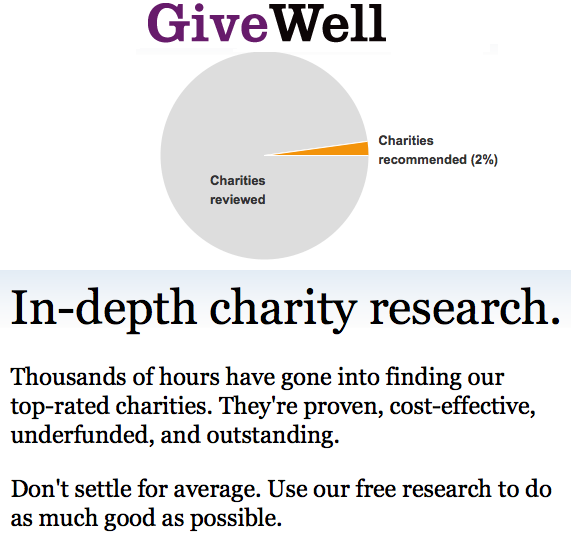
- Affordable, Effective Charities! Against Malaria Foundation or Schistosomiasis Control Initiative (GiveWell's current top-rated charities)
- Research on Effective Charities! Not all non-profits are equal. To figure out the good from the bad, check out GiveWell. Another charity watchdog is Charity Navigator.
- Get Involved! A group of philosophers run Giving What We Can, dedicated to following and promoting Peter Singer's argument to give.
Tuesday, December 18, 2012
Extra Credit: "I Could've Done More"
Optional extra credit: Explain how Peter Singer thinks that we are in a similar situation as Oskar Schindler in this scene from Schindler's List. Do you agree with Singer? Why or why not?
The assignment doesn't have to be long (only about a paragraph). It's based on the Peter Singer article on pages 229-236 of the yellow textbook, and is due at the beginning of class on Friday, December 21st. It's worth up to 10 points added to your final grade.

The assignment doesn't have to be long (only about a paragraph). It's based on the Peter Singer article on pages 229-236 of the yellow textbook, and is due at the beginning of class on Friday, December 21st. It's worth up to 10 points added to your final grade.
Monday, December 17, 2012
New Jersey's Own
 Here's more than you ever wanted on Peter Singer:
- His recent book on giving is called The Life You Can Save.
- Here he points out the biases that keep us from giving.
- Here he calls out professors for not teaching about poverty.
- Here he updates his argument and offers some specific giving guidelines.
- Here he defends his position against some tough questions.
- And here's his recent appearance on The Colbert Report.

Sunday, December 16, 2012
Torture
Here are some links on the ethics of torture:

- The Stanford Encyclopedia of Philosophy article on torture
- Mark Bowden's survey of interrogation practices
- The United Nation's Convention Against Torture
- Audio interview on the depicted use of torture in the movie Zero Dark Thirty:
Saturday, December 15, 2012
Assisted Dying
Here are a few links on euthanasia:

- Some related ethical issues--like suicide and advanced directives--get their own entries in my favorite free online philosophy encyclopedia.
- The active/passive distinction highlights broader ethical worries: the difference between doing and allowing harms, and the doctrine of double effect.
- Tons of articles, videos, and other resources on euthanasia are available here.
- Last year, a moral philosopher was diagnosed with a brain tumor and wrote an article titled "It is monstrously wrong that patients cannot ask for euthanasia."
- In 1997, some well-known philosophers filed an amicus brief to the U.S. Supreme Court arguing in favor of euthanasia. The court didn't listen: in two separate cases later that year, it decided in favor of upholding bans on euthanasia.
Thursday, December 13, 2012
Poetic Idol Tonight

It's in the CIM Auditorium from 7:00-9:00 tonight. You can perform or just watch. There's free food for all.
Friday, December 7, 2012
Your Inner Bigot
There's an insightful article called "Finding Your Inner Bigot"
on racism and
sexism that relates to our discussion in class this week: does prejudice have to be conscious, or can we unintentionally
do something sexist or racist?
Psychological evidence suggests that unconscious prejudice is real, and often a bigger problem today than intentionally discriminatory behavior. As the article puts it,

Psychological evidence suggests that unconscious prejudice is real, and often a bigger problem today than intentionally discriminatory behavior. As the article puts it,
"If you ask physicians whether all patients should be treated equally regardless of race, everyone says yes. But if you ask doctors how they will treat patients with chest pains who are named Michael Smith and Tyrone Smith, the doctors tend to be less aggressive in treating the patient with the black-sounding name. Such disparities in treatment are not predicted by the conscious attitudes that doctors profess, but by their unconscious attitudes—their hidden brains."Counteracting these unintentional, hidden prejudices is pretty tough. They require a long-term approach of the kind discussed in Aristotle's virtue ethics: noticing your bad habits, then consciously trying to break them and replace them with better habits. The hardest part about unconscious biases, though, is how difficult they are to notice in the first place.
Thursday, December 6, 2012
Do You Remember? Prolly Not
Here's a video on the unreliability of eyewitness identification and the tragedy of misidentifying a suspect:
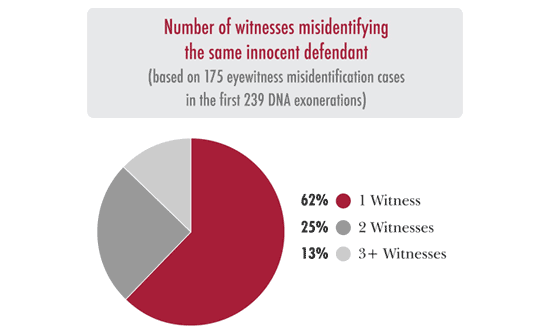
Unfortunately, many jurors seem to prefer eyewitness testimony over forensic evidence. Given how unreliable our memories are, that's pretty scary. Here's a quote:

Finally, here's an excellent, short video explanation of the unreliability of memory that ends with a dog licking peanut butter off a guy's face:
Unfortunately, many jurors seem to prefer eyewitness testimony over forensic evidence. Given how unreliable our memories are, that's pretty scary. Here's a quote:
"Despite all our scientific know-how, jurors weighing life and death decisions still crave what Leone calls the 'human element:' the act of watching another person testify and deciding if they’re telling the truth.
"As these witnesses enter the courtroom, a hush often falls on the gallery. Jurors — bored by days of dry testimony given by well-rehearsed experts — lean forward in their seats, pens at the ready to take notes about what the eyewitness has to say. They have seen this moment on television, too, and it’s usually really, really interesting."
Finally, here's an excellent, short video explanation of the unreliability of memory that ends with a dog licking peanut butter off a guy's face:
Wednesday, December 5, 2012
Unfair and Arbitrary
Here are some links related to Nathanson's article outlining the problems in the U.S. legal system:

- Here's a decent overview article on measuring the reliability of the justice system. How often do courts convict the wrong person?
- Brandon Garrett researched 250 cases in which DNA evidence overturned wrongful convictions. His book is Convicting the Innocent. One of his big points is just how unreliable eyewitness memory can be.
- Most of us don't realize just how much of our memories are complete fabrications. In other words, our memory doesn't work the way we think it does.
- Studies show that arbitrary factors often influence verdicts, such as a defendant's attractiveness, or accent, or willingness to smile, or display of emotion in the courtroom.
- And judges aren't above such biases: judges' verdicts are influenced by all sorts of weird factors, like the time of the day the verdict is made.
- Another big problem is the two-tiered court system: we seem to have one set of rules for the wealthy and powerful, and another set of rules for the rest of us.
Tuesday, December 4, 2012
Crime and Punishment
While we're on the subject of capital punishment, here's some stuff on new research into punishment:
- Mark Kleiman, professor of public policy at UCLA, has a new book called When Brute Force Fails: How to Have Less Crime and Less Punishment. He argues that smaller, swifter punishments can greatly increase deterrence.
- Here's a review of When Brute Force Fails.
- Kleiman runs a blog called Same Facts.
- Here's a video dialogue about Kleiman's book:
Monday, December 3, 2012
Death Penalty Box
Here are some links related to our discussion of the death penalty:

- An encyclopedia of philosophy article on the death penalty.
- A large collection of resources on the ethics of capital punishment. I mean, wow.
- What's up with punishment in general? That's a big ethical issue.
- What about the financial cost of the death penalty? Although it's common sense to think that keeping a criminal in prison for life would cost more than putting her to death, studies suggest that the opposite is true. The additional legal battles in death penalty cases may cost more than a life sentence.
- Of course, for some death penalty opponents, it's not about whether innocent people are sentenced to death.
Sunday, December 2, 2012
Does Death Harm Animals?
Here is a short post with some thoughtful analysis regarding the topic of our 2nd paper on the moral status of persons (specifically, on non-persons and killing animals):
I recommend reading it to help you start developing your own arguments on these issues for your paper.

I recommend reading it to help you start developing your own arguments on these issues for your paper.
Saturday, December 1, 2012
New Jersey's Own
An article we're reading toward the end of the semester was written by by well-known philosopher, utilitarian, vegetarian, and New Jersey resident Peter Singer. He's particularly known for arguing in support of better treatment of animals. Here are some interviews with him:
- Peter Singer on Michael Vick & Dog Fighting
- Audio Interview with Peter Singer
- Animal Research (Peter Singer's Sometimes OK with It!)
Thursday, November 29, 2012
The Ethics of Killing
 I don't often recommend an entire book to students, but if you're interested in some thoughtful analysis of abortion, euthanasia, animals, killing, and personhood, among other things, you should check out Jeff McMahan's The Ethics of Killing. Here's a short description of the book:
"This magisterial work is the first comprehensive study of the ethics of killing, where the moral status of the individual killed is uncertain. Drawing on philosophical notions of personal identity and the immorality of killing, McMahan looks carefully at a host of practical issues, including abortion, infanticide, the killing of animals, assisted suicide, and euthanasia."McMahan teaches philosophy at Rutgers. He also just wrote a follow-up book called Killing in War. This is exactly the kind of careful, thought-out approach that I think complicated, serious issues deserve.
Here's an audio interview with McMahan on personhood.
Wednesday, November 28, 2012
You Know Chicken's Chicken, Right?
Jonathan Safran Foer--author of the critically acclaimed novel Everything Is Illuminated--has a new book about his decision to not support factory farming called Eating Animals. Here's some stuff on it:
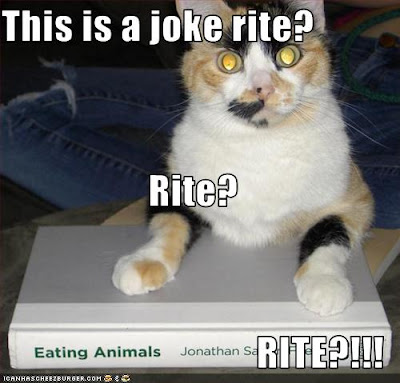
- A thoughtful review of the book by a philosopher.
- Another review: "You Know That Chicken Is Chicken, Right?"
- His appearance on the Colbert Report:
Tuesday, November 27, 2012
Moopheus
Here are some links on animal ethics:

- David Foster Wallace: Consider the Lobster
- How to Cut Back on Meat Slowly
- What Is The Meatrix? (see video below)
- Vegetarians Still Love the Smell of Bacon
- What If We Could Make Pain-Free Animals?
- Audio Interview: Jeff McMahan on Vegetarianism
- Huge List of Resources on the Moral Status of Animals
Thursday, November 22, 2012
Abortion
Here are some links related to our class discussions on the ethics of abortion:

- Recent scientific research suggests that the earliest fetuses can feel pain is about 24 weeks into a pregnancy.
- One philosopher argues that even if you think abortion is morally acceptable, it's controversial and morally risky enough for you to lower your confidence in your own moral judgment.
- Here are two articles debunking the myth of the Mozart Effect that we discussed in one of our classes.
Wednesday, November 21, 2012
Personhood
Here are some links related to our ongoing discussion of the the moral status of persons:

- Here is the Catholic Encyclopedia entry on person.
- Here is a nice essay that examines various proposed criteria for personhood, such as intelligence and the ability to communicate.
- Are dogs persons? One of my favorite radio shows recently devoted 3 episodes to the science of what dogs can and cannot understand. Listen below:
Part One
Part Two
Part Three - How about dolphins: are they sea-persons?
Tuesday, November 20, 2012
Moral Psych Out
Here are some links loosely related to moral psychology:
- Here's a decent explanation of Lawrence Kohlberg's psychological theory of moral development that we mentioned in class.
- Psychological research on our moral judgments is a lot wackier today. For instance, clean smells make us behave better, while smelling farts makes us judge more harshly.
- There's some great new research on moral development in children, too. Here's Rebecca Saxe's TED Talk:
- One large strand of psychological research is on the impact of emotions on our moral reasoning. Here's Jonathan Haidt's TED Talk on the emotional difference between conservatives and liberals:
Subscribe to:
Posts (Atom)