- Here's a decent explanation of Lawrence Kohlberg's psychological theory of moral development that we mentioned in class.
- Psychological research on our moral judgments is a lot wackier today. For instance, clean smells make us behave better, while smelling farts makes us judge more harshly.
- There's some great new research on moral development in children, too. Here's Rebecca Saxe's TED Talk:
- One large strand of psychological research is on the impact of emotions on our moral reasoning. Here's Jonathan Haidt's TED Talk on the emotional difference between conservatives and liberals:
Showing posts with label theories. Show all posts
Showing posts with label theories. Show all posts
Tuesday, November 20, 2012
Moral Psych Out
Here are some links loosely related to moral psychology:

Monday, November 19, 2012
Delusions of Gender
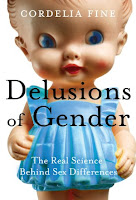
Fine wrote a nice summary of her book here, and there are two good reviews of her book here and here. Below is an excerpt from a talk Fine recently gave.
Cordelia Fine: Discovering Sexism in Neuroscience
Here's a comparison of the different words used in ads for boys’ toys and ads for girls’ toys.


Sunday, November 18, 2012
Ethics of Care
Here's some stuff related to the ethics of care:

- Here's an excerpt from a video of Carol Gilligan explaining her work. The entire video is available here.
- For stuff on feminism in general, I highly recommend one of my favorite blogs: Feminist Philosophers.
- There's also a great blog called What Is It Like to Be a Woman in Philosophy? It's devoted to short accounts from women on their experiences while pursuing a career in philosophy.
- The cartoon Rose Is Rose offers a funny-ish critique of reason-centered approaches to ethics:
Saturday, November 17, 2012
Breaking Habits
"If you want to change a habit, …don’t try and change everything at once. Instead, figure out what the cue is, figure out what the reward is and find a new behavior that is triggered by that cue and delivers that same reward."

Friday, November 16, 2012
Just Right
Here is a trio of short audio interviews with philosophers talking about Aristotle's virtue ethics. All three interviews come from the "Philosophy Bites" podcast.
And here's a great overview on the current science of self-improvement: when trying to change something about yourself, which techniques work and which don't?

And here's a great overview on the current science of self-improvement: when trying to change something about yourself, which techniques work and which don't?
Wednesday, November 7, 2012
Midterm Exam
Just a reminder: the midterm exam is Friday, November 9th. It's worth 15%
of your overall grade, and will cover everything we've done in
class so far:
The test is a mix of short-answer questions, argument evaluations, and essays. You'll have all 50 minutes of class to take it.

- Doing Philosophy
- Understanding and Evaluating Arguments
- Moral Skepticism vs. Moral Realism
- Divine Command Theory
- Natural Law Theory
- Utilitarianism
- Kant's Ethics
- Virtue Ethics
- Ethics of Care and Feminist Criticisms of Traditional Theories
The test is a mix of short-answer questions, argument evaluations, and essays. You'll have all 50 minutes of class to take it.
Friday, November 2, 2012
Paper #1 Guideline
New Due Date: the beginning of class on Monday, November 12th, 2012
Due Date: the beginning of class on Monday, November 5th, 2012
Worth: 5% of your overall grade
Assignment: Write an essay on one of the topics below in which you support your opinion with an argument. Papers must be typed, and must be between 400-700 words long. Provide a word count on the first page of the paper. (Most programs like Microsoft Word have automatic word counts.)
Possible Paper Topics (Choose ONE of the following topics)
1. Defend a Theory. Out of the seven ethical theories that we’re studying—moral relativism, divine command theory, natural law theory, utilitarianism, Kant’s ethical theory, Aristotle’s virtue ethics, or Gilligan’s ethics of care—which do you think is best? Why? What are two of the best criticisms that someone might make to that theory? How do you reply to those criticisms to defend this theory? Be sure to fully explain & defend your position.
2. Criticize a Theory. Provide a detailed criticism of one of the seven ethical theories we’ve discussed in class. First, briefly explain the theory, and present what you take to be the best criticism(s) of the theory. Then critically evaluate your criticism(s). That is, consider how someone who supports the theory might respond to your criticisms, and explain why you think these responses are unsuccessful.
 3. Moral
Realism. Moral realists believe (a) moral claims are objectively true or
false. Many moral realists also believe (b) there are no authorities whose
decrees make things morally right or wrong. Are these two claims consistent with
each other? Be sure to fully explain & defend your answer.
3. Moral
Realism. Moral realists believe (a) moral claims are objectively true or
false. Many moral realists also believe (b) there are no authorities whose
decrees make things morally right or wrong. Are these two claims consistent with
each other? Be sure to fully explain & defend your answer.
4. Facts, Opinions, & the Hitler Intuition. In class, we’re discussing the “Hitler Intuition”: Many people think that Hitler’s moral beliefs were not just different from ours; they were mistaken. Many use this intuition as evidence against moral relativism, and support for moral realism. Examine this intuition.
6. Choose Your Own Adventure! Write on a topic of your choosing related to some or one of the ethical theories we’ve discussed in class. (Sean must approve your topic by Friday, March 9th).
NOTE: This is not a research paper! I expect you to explain and defend these theories based on our discussions in class. You are not expected to do any outside research. (If you do, however, be sure to cite your sources.)
Due Date: the beginning of class on Monday, November 5th, 2012
Worth: 5% of your overall grade
Assignment: Write an essay on one of the topics below in which you support your opinion with an argument. Papers must be typed, and must be between 400-700 words long. Provide a word count on the first page of the paper. (Most programs like Microsoft Word have automatic word counts.)
Possible Paper Topics (Choose ONE of the following topics)
1. Defend a Theory. Out of the seven ethical theories that we’re studying—moral relativism, divine command theory, natural law theory, utilitarianism, Kant’s ethical theory, Aristotle’s virtue ethics, or Gilligan’s ethics of care—which do you think is best? Why? What are two of the best criticisms that someone might make to that theory? How do you reply to those criticisms to defend this theory? Be sure to fully explain & defend your position.
2. Criticize a Theory. Provide a detailed criticism of one of the seven ethical theories we’ve discussed in class. First, briefly explain the theory, and present what you take to be the best criticism(s) of the theory. Then critically evaluate your criticism(s). That is, consider how someone who supports the theory might respond to your criticisms, and explain why you think these responses are unsuccessful.
3. Moral
Realism. Moral realists believe (a) moral claims are objectively true or
false. Many moral realists also believe (b) there are no authorities whose
decrees make things morally right or wrong. Are these two claims consistent with
each other? Be sure to fully explain & defend your answer.4. Facts, Opinions, & the Hitler Intuition. In class, we’re discussing the “Hitler Intuition”: Many people think that Hitler’s moral beliefs were not just different from ours; they were mistaken. Many use this intuition as evidence against moral relativism, and support for moral realism. Examine this intuition.
-If you agree that it is solid evidence for moral realism, explain exactly how this intuition works. What makes it objectively true that Hitler was immoral? What is the basis of your judgment? In other words, what makes moral claims objectively true? Which ethical theory we’ve discussed do you think this supports? Explain and defend all your answers.5. The Euthyphro Dilemma. The most common criticism of divine command theory is the Euthyphro dilemma: “Is an action good because God commands it, or does God command it because it is good?” Explain and evaluate this criticism. How is it a criticism of divine command theory? Do you think this is a good or bad criticism of divine command theory? Be sure to fully explain & defend your answer.
-If you do not believe that this intuition is solid evidence for objective morality, you are probably a relativist. Explain why this intuition doesn’t provide enough evidence for the existence of an objective morality. Why is it OK to say that Hitler’s actions weren’t objectively immoral? How is it that Hitler is simply bad to me, but not objectively bad?
6. Choose Your Own Adventure! Write on a topic of your choosing related to some or one of the ethical theories we’ve discussed in class. (Sean must approve your topic by Friday, March 9th).
NOTE: This is not a research paper! I expect you to explain and defend these theories based on our discussions in class. You are not expected to do any outside research. (If you do, however, be sure to cite your sources.)
Thursday, November 1, 2012
Everybody Thinks They're a Good Person

Friday, October 26, 2012
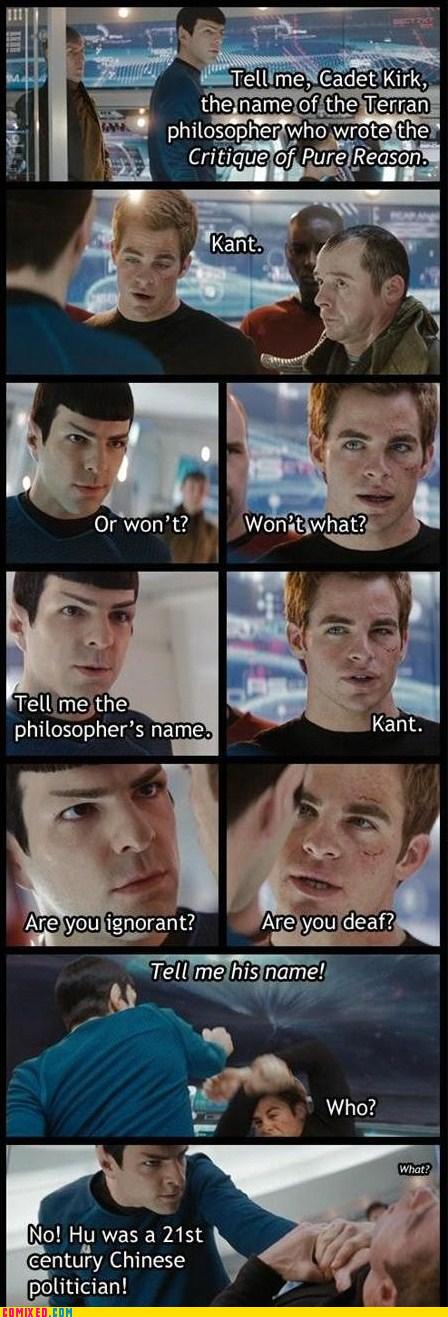
Thursday, October 25, 2012
Kantian Links
Here are some links related to Immanuel Kant's theory of ethics:

- An intermediate overview of Kant's theory of ethics.
- An advanced overview of Kant's ethics.
- Kant's theory is deontological (which is a fancy word that basically means morality is about more than just the consequences of an action). Here's an advanced overview of deontological ethics.
- Some harsh criticisms of Kant's ethical judgments. My favorite excerpt: "Kant's philosophical moral reasoning appears mainly to have confirmed his prejudices and the ideas inherited from his culture. Therefore, we should be nervous about expecting more from the philosophical moral reasoning of people less philosophically capable than Kant."
- A 3-minute video on Kant's ethics is below:
Wednesday, October 17, 2012
The Psychology of Happiness
Since utilitarianism focuses so much on happiness, I thought I'd share some links on the cool new psychological research on happiness popping up lately.
- Here's a great overview of the psychology of happiness. And here is another, and another.
- Recent studies suggest that our baseline level of happiness doesn't change much throughout our life. So, even if we won the lottery, we wouldn't wind up that much happier. This is potentially very depressing news, although some say there's room for some optimism, and others think the research is wrong.
- There's an insightful, accessible book by Harvard psychologist Dan Gilbert called Stumbling on Happiness. One of his big points is that we often don't know what makes us happy. Here's Gilbert's appearance on The Colbert Report:
- And here's Gilbert giving an awesome TED talk on his research:
Tuesday, October 16, 2012
Utilitarios

Here are some links on the theory of utilitarianism:
- A neat little biography of know-it-all John Stuart Mill.
- An advanced encyclopedia article from my favorite free online philosophy encyclopedia on utilitarianism and other theories that focus on consequences of an action.
- (Yes, there is more than one free online philosophy encyclopedia. Here's another encyclopedia's entry on the same topic.)
- The trolley problem gets brought up a lot when evaluating utilitarianism. A short video intro on it is below. Also, there's some new research on the psychology of the trolley problem.
Wednesday, October 10, 2012
Natty Law
Here's a Bloggingheads video dialogue explaining and debating natural law theory:
Bloggingheads is a great resource that I've learned a lot from. They post conversations between smart people on all sorts of interesting topics. I recommend browsing the site, or checking out some of my favorites.

Bloggingheads is a great resource that I've learned a lot from. They post conversations between smart people on all sorts of interesting topics. I recommend browsing the site, or checking out some of my favorites.
Thursday, October 4, 2012
Am I A Jerk Because I Annoy You, Or Do I Annoy You Because I'm A Jerk?
Let's evaluate divine command theory!
- Two quick explanations (one and two) of the Euthyphro dilemma, the big criticism of divine command theory
- Some responses to the Euthyphro dilemma
- Other criticisms of divine command theory
- Important question: do the robot gods love what is pious because it is pious, or is something pious because it is loved by the robot gods?
- Let's hear God's response:
- But for obvious reasons, this one's my favorite:
Wednesday, October 3, 2012
God Ethics
Here are some links on divine command theory:

- A really nice overview of divine command theory
- A more advanced overview of divine command theory
- An article on the relationship between religion and morality
- Lots of philosophy links related to the broader question of whether there is or is not a god
Subscribe to:
Posts (Atom)